
I attended the first three days of NVIDIA GTC 2025. It was impressive to see how AI is fundamentally transforming various industries. For me, the key highlights of AI impact outside of the AEC industries were in movie and automotive making and in workplace automation.
Media & Entertainment: AI as a Creative Collaborator in Filmmaking
The movie industry is shifting from polygons and traditional computer-generated imagery (CGI) to an AI-driven approach. Artists now collaborate with AI scientists to train models that enhance storytelling to reduce the time and cost of movie-making, which could be huge.
For example, remember The Curious Case of Benjamin Button, the film about a man (played by Brad Pitt) who ages in reverse? The director hired over 200 people over two years to achieve the aging effects, spending over $10 million. Today, AI can accomplish the same effect in real time instead of years. This talk by Jo Plaete and Ed Ulbrich explores how, in the movie Here, Tom Hanks and Robin Wright were aged in real time using AI.

Automotive: AI-Accelerated Design from Concept to Production
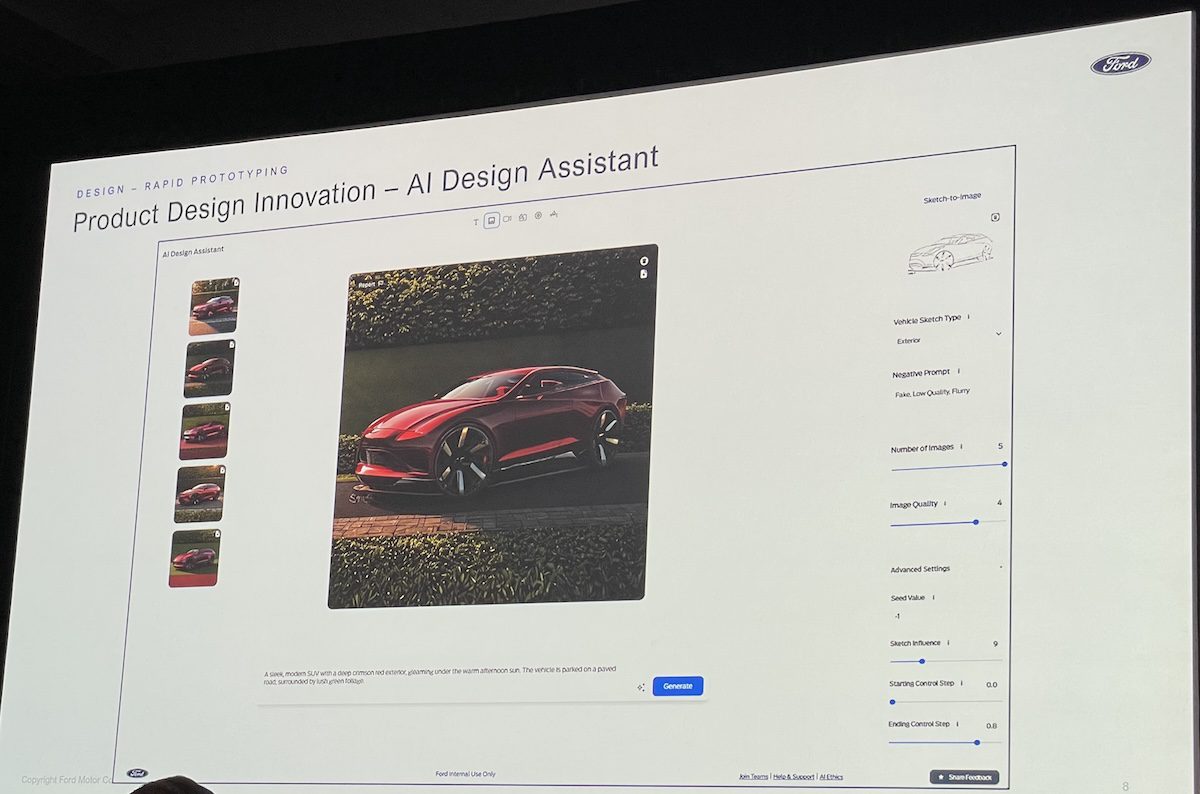
Automakers also leverage AI to streamline the whole lifecycle of car design and manufacturing. Ford, for example, demonstrated how car designers use AI to turn rough sketches into refined designs in minutes instead of weeks.
Besides aesthetic design, using AI in engineering analysis reduces the simulation time from 15 hours to just 10 seconds. The results showed that AI-generated designs are as good as traditional designs, exploring more design alternatives and speeding up production. If you’re interested in learning more, you can watch the full session here.
Workplace Automation: AI Assistants as a Scalable Team Member
Do you know how many support tickets Uber has to process in a year? Over 500 million! Assuming one person can handle 100 tickets a day, Uber needs more than 13,000 people just to handle support tickets, equivalent to roughly one billion dollars in operational cost. With AI advancement, Uber uses AI agents to handle the majority of tickets, improving their response times and significantly reducing their operational costs.
Within enterprises, AI assistants are becoming essential for HR, finance, and IT teams. Lockheed Martin has deployed its own AI assistant, serving 55,000 employees and processing 2-3 billion tokens daily (equivalent to analyzing and generating hundreds of millions of words per day). This scale of AI usage demonstrates the deep integration of AI in automating routine queries and reducing employee workload to focus on higher-value work.
The Big Picture?
What stood out to me at GTC wasn’t just the technical innovation but also the speed and scale of real-world adoption. AI is no longer a futuristic promise; it’s already transforming every industry. The common thread across media, automotive, and several enterprises was how AI is becoming a new collaborator, not a replacement.
As AI transforms existing workflows, the key question for every leader is no longer whether AI will affect their industry but how fast and ready they are to adapt.
So, I’ll leave you with this: How are you preparing your organization for this big shift?
Join 5000+ Visionary Leaders
Free insights on AI strategy, leadership, and the future of AEC, delivered to your inbox.
Subscribe to Newsletter